Author

Henry

Deadlifts

The deadlift is a great way to build strong legs and butt. In a deadlift, you lift weight from the ground to thigh level using primarily your leg and hip muscles, but with the assistance of most of the large muscle groups of your body. The deadlift is usually performed with a bar and plates or a stationary barbell, but you can do it with dumbbells. It is a specialty of powerlifters that you shouldn’t ignore in general fitness training. Make deadlifts part of your strength-training workouts to build muscle and functional fitness.

How to Perform a Deadlift

Select a lightweight barbell or two dumbbells.

  1. Grasp the bar just outside the line of your knees with an overhand or mixed grip.
  2. Place your feet shoulder-width apart (or not much more) with toes under the bar. Your feet point straight ahead, or they can angle out slightly. Heels should stay flat on the surface. As you lift and lower the bar, it will travel close to the shins and may even graze them. Maintain a neutral spine position.
  3. Engage your abdominal muscles.
  4. Slowly bring the weight down as far as you can while maintaining proper form, softening your knees, and keeping your back flat.
  5. Lift the bar by pushing upward with the legs from the knees. Breathe out on exertion. Be careful not to raise the hips first so the trunk moves forward and the back becomes rounded. Don’t try to haul the bar up with your arms. The arms stay extended under tension while gripping the bar as the legs push up. Think of the legs and shoulders moving upward in unison with the hips, the balancing point.
  6. The bar should almost graze the shins and rest around the thighs as you reach full height. Pull the shoulders back as much as possible without bending backward.
  7. Lower the bar toward the floor with a reverse motion ensuring a straight back.
  8. Repeat for your desired number of repetitions.

Benefits of Deadlifts

The deadlift uses the hamstrings (back of thigh), quadriceps (front of thigh), gluteals (butt), and lower back muscles (erector spinae). The stabilizer muscles of the core, abs, shoulders, and upper back also come into play. Deadlifts: Proper Form, Variations, and Common Mistakes

Builds Muscle Mass

Deadlifts have a great reputation for building muscle mass, which is desirable for bodybuilders and people who want to prevent or reverse muscle loss due to aging. You can use deadlifts to build overall strength, core strength, and stability.

Boosts Metabolism

Your metabolism determines how many calories you burn at rest. Lean muscle speeds your metabolism. By increasing the amount of lean muscle in your body, you can help give your metabolism a boost. Since deadlifts work with some of the largest muscle groups in the body, they are a good choice for building a greater percentage of lean muscle in your body. Deadlifts: Proper Form, Variations, and Common Mistakes

Builds Functional Fitness

The deadlift is one of the best exercises for mimicking the the lifting you perform during the day, so it is a functional exercise. Learning to deadlift with good form, you will be able to lift and carry items with less risk in daily life.

Other Variations of Deadlifts

You can do deadlift variations to suit your goals and fitness level. Several advanced variations are possible with alternative leg and grip positions.

As with all exercises, if you are new to deadlifting, lift only light weights or even a bar without any additional weight. Have a personal trainer coach you and give feedback on your form. Increase weight when you are performing it correctly. Deadlifts: Proper Form, Variations, and Common Mistakes

Dumbbell Deadlifts

If you are unable to access to a barbell or the bar’s weight is too challenging, try a kettlebell or vertical dumbbell deadlift with a lighter weight. Grasp the object with both hands and hinge at the hips to lift it, as with a barbell. Alternatively, workout sandbags can be used for a variety of full-body exercises, including deadlifts.

Romanian Deadlifts

The main difference between Romanian deadlifts and regular deadlifts is that instead of starting the lift from a squat, Romanian deadlifts start the lift from a standing position. This variation works the posterior chain muscles, which include the muscles that run along the back side of your body, such as the glutes, hamstrings, and calves.

You can also do the Romanian deadlift with offset feet, which may more closely mimic real-life situations in picking up and moving heavy objects. Deadlifts: Proper Form, Variations, and Common Mistakes

Stiff-Leg Deadlift

In this version of deadlifts, you remain standing during the entire motion, keeping your legs stiff and your knees almost locked. Maintain a neutral spine and keep the bar close to your body as you bend forward and return to standing. The stiff leg deadlift activates the hamstrings and gluteus maximus more than standard or Romanian deadlifts.

Suitcase Deadlift

Lifting weight is necessary for this version on one side of the body at a time, using only one hand. Imagine the movement of picking up a suitcase. It is excellent for strengthening your core, as you engage those muscles to prevent your body from leaning over to the side with the weight. This movement requires bending as if to squat, as in a standard deadlift, rather than keeping straight legs. Deadlifts: Proper Form, Variations, and Common Mistakes

Change Your Deadlift Grip

These are the possible grip types while performing deadlifts:

  • The standard overhand grip has both hands with palms facing the body. If you can see the backs of both hands, that’s the overhand grip. This grip is suitable for lighter weights.
  • The mixed grip has one hand grasping the bar with the palm under the bar (supinated) and the other with the palm over the bar (pronated). The mixed overhand-underhand grip is for heavier weights. This grip provides some reassurance that heavier weights will not slip from the hands.

The grip can be wider or narrower on the bar. A typical starting position is a grip perpendicular to the point of the shoulder with arms straight down. A slightly wider grip may suit some people, and a wide-grip deadlift is a valid variation. The standard grip utilizes the quadriceps (rather than the hip and back with the wide grip) and is more suitable for heavier lifts. Deadlifts: Proper Form, Variations, and Common Mistakes

Deadlift Common Mistakes

Deadlifts have so many benefits, but doing them correctly is paramount. Injury from deadlifts could leave you unable to exercise while you recover, so it’s not worth taking risks. Avoid these errors so you can get the most out of this exercise with less risk of strain or injury.

Rounding Your Back or Shoulders

Maintain a straight back with no rounding at the shoulders and spine. You should be hinging at the hip. Keep those hips down, butt out. Engage your core to support your straight back.

Lifting With Your Arms or Back

For beginners, the key to the lifting process is to lift with the legs and hips, not the arms, shoulders, or back—although their stabilizing role is important. Keep your arms straight throughout the deadlift. Bending your arms can strain your biceps. Deadlifts: Proper Form, Variations, and Common Mistakes

Using Too Much Weight

When starting, practice with light weight until ​your form is satisfactory. A personal trainer or gym attendee can check you for the correct form. Practice in a mirror if necessary. You can add weight as your fitness increases, but it’s better to do so modestly so you don’t strain your muscles. As with all weightlifting exercises, proper footwear, like these best CrossFit shoes, is essential.

Partial Lifts

With a light weight, you can do repetitions in which you lower the bar to your shin or even floor and then straighten again without releasing your grip on the bar. This is not truly a deadlift repetition. It is better to practice a full lift, lower to the floor, and start again from a standing position.

Bar Too Far From Body

Occasionally, when someone deadlifts, they position the weight too far away from the body. The bar should travel close to the body for maximum lift efficiency and safety. It’s OK to skim the front of your legs as you lift and lower. With Deadlifts: Proper Form, Variations, and Common Mistakes

Safety and Precautions

The deadlift is an advanced weightlifting exercise. Talk to a healthcare provider to see if it is appropriate for you if you have any injuries or conditions affecting your legs, knees, ankles, hips, back, shoulders, or wrists. Be sure you receive appropriate coaching for the correct technique. Use light weights to start, and stop if you feel any pain. In pregnancy, it is best to use lighter weights, and you may wish to use the wider sumo stance. Women should consider wearing a high-neck sports bra for extra support.

0 comment
0 FacebookTwitterPinterestEmail
Desk Treadmills

These sturdy and compact picks will help you meet your step count goals

If your job requires a lot of time sitting at a desk, there’s a good chance you have difficulty reaching your daily step goal. Fortunately, using a walking pad is an easy way to increase your movement during a workday. It can support attempts to lose weight as well, since it bumps up your daily activity level and calorie burn. However, it should still be accompanied by moderate to vigorous physical activity. Quieter and more compact than fitness treadmills, the best walking pads should still deliver similar sturdiness and ease of use to let you walk confidently and safely.

To find the best walking pads and under-desk treadmills on the market, we consulted an athletic trainer and personal trainer on which key features to look for. We then tested ten of the most popular picks at home over the span of four weeks, by completing a minimum of four walks per week. When creating our final list of recommendations, we considered the assembly process, ease of use, foldability, special features, comfort, and overall value. A certified personal trainer from our Review Board also assessed this article for accuracy.

Best Overall

Egofit Walker Pro-M1 Treadmill

Our Ratings

  • Ease of Setup  5/5
  • Ease of Use 7/5
  • Foldability 5/5
  • Features 5/5
  • Value 9/5

Pros

  • Compact and easy to use
  • 5% incline
  • Quiet operation

Cons

  • No handrail
  • Lower maximum speed

Key Specs:

Dimensions: 21.9 x 38.4 x 6.9 inches Maximum Weight Capacity: 220 pounds | Speed Range: 0.5 to 3.1 MPH Incline Range: 0% and 5% (fixed) Product Weight: 48.5 pounds | Remote Control: Yes | Wheels: Yes | Our Overall Rating: 4.9/5

Who It’s For

Great for walking while taking calls and when working from a standing desk.

Why We Love It

Egofit’s Walker Pro-M1 Under Desk Treadmill’s compact design, silent and simple to use, and extra features make it an easy pick for our best overall spot. It comes pre-assembled and ready to use right out of the box. When testing, we found the treadmill to be extremely quiet—we’ve even been able to take work calls while getting our steps in. We are also appreciative of the LCD panel lets us track our steps, distance, speed, time, and calories burned. We Tested the Best Walking Pads and Under-Desk Treadmills—These 7 Are Worth It

Unlike other models, the Walker Pro-M1 has a 5% incline option, which helps crank up the calorie burn during your walking workouts. Remember that this is a fixed (non-adjustable) incline, so you can only set the incline to zero percent (i.e., flat) or 5%—nothing in between. We also appreciate that the treadmill’s wheels allow us to easily move it to our preferred storage spot once the workout’s over.

Potential Flaws

  • With a maximum speed of 3.1 miles per hour, you won’t be able to walk as fast on this option compared to others on our list.
  • The treadmill doesn’t have handrails, so it may not be the best option for those with balance issues who need something to hold onto while they walk.

Best Walking Pad

WalkingPad C2 Folding Treadmill

Our Ratings

  • Ease of Setup 5/5
  • Ease of Use 5/5
  • Foldability 4.5/5
  • Features 4.2/5
  • Value 5/5

Pros

  • Easy to set up and use
  • Quiet operation
  • Foldable, compact design

Cons

  • May be too short for taller users
  • No handrail

Key Specs:

Dimensions: 20.4 x 56.9 x 4.9 inches Maximum Weight Capacity: 220 pounds | Speed Range: 0.5 to 3.72 MPH Incline Range: None Product Weight: 55 pounds | Remote Control: Yes | Wheels: Yes | Our Overall Rating: 4.6/5

Who It’s For

Best for shorter users who have limited storage space.

Why We Love It

For a basic, space-saving walking pad that’s easy to use, it’s tough to beat WalkingPad’s C2 Foldable Walking Treadmill. Setting up the treadmill is simple and straightforward since it comes pre-assembled—we just had to unfold it and plug it in to get started. The small footprint and foldable treadmill design make this a solid pick for those with limited space. We Tested the Best Walking Pads and Under-Desk Treadmills—These 7 Are Worth It

We have fast access to adjust the treadmill’s speed using the remote, and the LCD monitor lets us view our steps, speed, time, and distance in real time from the device. The four-layer running belt allows for good shock absorption and noise reduction. Plus, we love that when finished, we can simply fold it in half and store it under a desk, couch, or bed. Two rollers on the bottom make maneuvering it from one spot to another easy.

Potential Flaws

  • We feel this treadmill would be more stable and safe to use if it had a handrail.
  • The walking surface felt a bit narrow to us and may not be comfortable for those with large feet or longer legs.

Most Affordable

GOPLUS Under Desk Treadmill

Our Ratings

  • Ease of Setup 5/5
  • Ease of Use 5/5
  • Foldability 5/5
  • Features 3/5
  • Value 8/5

Pros

  • Easy to set up and use
  • Good for beginners
  • Comfortable and stable

Cons

  • No handrail
  • Emits humming sound

Key Specs:

Dimensions: 23.5 x 51.5 x 6 inches | Maximum Weight Capacity: 220 pounds | Speed Range: 0.5 to 4 MPH | Incline Range: None | Product Weight: 55.5 pounds | Remote Control: Yes | Wheels: Yes | Our Overall Rating: 4.6/5

Who It’s For

Best for users looking for a budget-friendly option and who don’t mind a little noise.

Why We Love It

The GOPLUS Under Desk Treadmill is the most budget-friendly model we tested, making it a great option for those who just want a basic walking pad for getting their daily steps in. It’s easy to set up and use, and while it’s not feature-packed, it includes a remote and an LED screen that displays speed, distance, time, and calories burned. We Tested the Best Walking Pads and Under-Desk Treadmills—These 7 Are Worth It

The treadmill comes fully assembled, thus all we had to do was open it to get going, attach the power cord, and plug it into the wall. Because of the attached remote, it’s extremely easy to turn on the treadmill and adjust the speed with just a click of a button.

Potential Flaws

  • We noticed a humming sound while using the treadmill, which could distract some, especially during work calls.
  • A folding handlebar would make the treadmill more stable during use.

Best for Petite Users

Sunny Health & Fitness Under Desk Treadmill

Our Ratings

  • Ease of Setup 4.2/5
  • Ease of Use 4.1/5
  • Foldability 4.5/5
  • Features 4/5
  • Value 4.5/5

Pros

  • Comfortable and easy to use
  • Display screen with stats
  • Small footprint

Cons

  • May be too short for taller users
  • No handrail

Key Specs:

Dimensions: 21.5 x 50 x 6.5 inches Maximum Weight Capacity: 220 pounds | Speed Range: 0.5 to 3.75 MPH | Incline Range: None | Product Weight: 55 pounds | Remote Control: Yes | Wheels: Yes | Our Overall Rating: 4.4/5

Who It’s For

Best for shorter users with a small stride length.

Why We Love It

Sunny Health & Fitness’s Under Desk Treadmill Workstation is another affordable option that’s comfortable and easy to use. It’s a bit shorter than some of the other ones we tested, but it’s a great option for petite users who want a treadmill with a small footprint. The machine comes pre-assembled—all we needed to do after unboxing it was use the included lubricant on the belt and plug it in. We Tested the Best Walking Pads and Under-Desk Treadmills—These 7 Are Worth It

During testing, the treadmill felt sturdy and fairly quiet. The display screen is located. to be appealing lets us easily track our speed, steps, distance, calories burned, and time elapsed. With wheels on the bottom, it’s easy to move and store away once we’re finished.

Potential Flaws

  • Like some other options on our list, this one also doesn’t have handrails, so it may not be suited to those who need help balancing while walking.
  • The walking surface is on the shorter side, so taller users may have difficulty walking on it comfortably.

Best Foldable

WalkingPad P1 Foldable Walking Treadmill

Our Ratings

  • Ease of Setup  5/5
  • Ease of Use 4.5/5
  • Foldability 5/5
  • Features 3/5
  • Value 4/5

Pros

  • Convenient foldable design
  • Easy to set up and use
  • Included remote displays stats

Cons

  • Not compatible with third-party apps
  • Shakes a bit when changing speeds

Key Specs:

Dimensions: 21.5 x 56.4 x 5 inches | Maximum Weight Capacity: 220 pounds | Speed Range: 0.5 to 3.75 MPH | Incline Range: None | Product Weight: 62 pounds | Remote Control: Yes | Wheels: Yes | Our Overall Rating: 4.3/5

Who It’s For

Best for users looking for a no-frills, compact walking pad to increase their step count.

Why We Love It

WalkingPad’s P1 Foldable Walking Treadmill is super easy to set up and use, but the folding design is what makes it truly stand out from the rest. When folded, its footprint is only 32.5 x 21.5 inches, making it easy to store under a desk or tuck away in another part of the room. At 62 pounds, it’s a bit heavier than some others we tested, but the foldable design and wheels on the bottom make it easy to move.

We also like that stats—including speed, steps, and distance—are displayed on the remote rather than on the treadmill’s display, which keeps us from craning our necks to see the data. We love that this pick is quiet and low-profile, allowing us to take work calls without distraction. We Tested the Best Walking Pads and Under-Desk Treadmills—These 7 Are Worth It

Potential Flaws

  • During testing, we noticed that the belt jerked a little when we changed the treadmill’s speed, so it’s essential to steady yourself before reducing or increasing it.
  • The treadmill isn’t compatible with third-party apps, so you won’t be able to track your stats via fitness apps like Apple Health.

Best for Small Spaces

WalkingPad A1 Pro Foldable Under Desk Treadmill

Our Ratings

  • Ease of Setup 5/5
  • Ease of Use 5/5
  • Foldability 5/5
  • Features 5/5
  • Value 3.8/5

Pros

  • Fits easily under furniture (beds, desks, etc.)
  • Super quiet
  • Easy on the knees

Cons

  • Machine is heavy
  • Bluetooth connectivity is spotty

Key Specs:

Dimensions: 21.5 x 56.5 x 6.5 inches Maximum Weight Capacity: 230 or 300 pounds | Speed Range: 0.5 to 3.72 MPH | Incline Range: Not listed | Product Weight: 61.73 pounds | Remote Control: Yes | Wheels: Yes | Our Overall Rating: 4.8/5

Who It’s For

Best for those with limited storage space.

Why We Love It

When your living space is smaller, choosing a walking pad that folds and fits under beds, dressers, or desks is imperative for efficient use of space. We love WalkingPad’s A1 Pro Foldable Under Desk Treadmill because of its unique design that folds over 180 degrees down to a thickness of only 4.7 inches and fits readily under furniture or in narrow spaces. Thanks to the wheels, it’s also super easy to transport.

We found this walking pad very easy to set up: After unboxing, we downloaded the app, registered our information, and were ready to go within five minutes. The pad is comfortable to walk on, and we love that it uses an algorithm to help pick a speed that suits your stride—and when we wanted to select our own speed manually, we were also able to do so quickly and efficiently thanks to the handy remote. We Tested the Best Walking Pads and Under-Desk Treadmills—These 7 Are Worth It

Potential Flaws

  • While this machine folds up compactly, it’s pretty heavy (over 60 pounds), making it difficult to move.
  • We struggled to automatically connect our iPhone to the treadmill via Bluetooth, but we were able to connect to it manually through the accompanying app.

Best Portable

LifePro PacerMini Pro Treadmill

Our Ratings

Ease of Setup 5/5

Ease of Use 5/5

Foldability 5/5

Features 4/5

Value 5/5

Pros

Weighs less than other options

Adjustable, foldable handlebar

Very quiet

Cons

Incline setting is fixed

Belt length is shorter than other options

Key Specs:

Dimensions: 25 x 32.7 x 7 inches Maximum Weight Capacity: 220 pounds | Speed Range: 0.5 to 3.0 MPH | Incline Range: 0% and 7% (fixed) | Product Weight: 40 pounds | Remote Control: Yes | Wheels: Yes | Our Overall Rating: 4.8/5

Who It’s For

Best for those who need to move their under-desk treadmill frequently.

Why We Love It

The small size and 40-pound weight of Lifepro’s PacerMini Portable Treadmill make it an easy choice for our best portable pick. It’s lighter than the other walking pads we tested and has built-in wheels for easy moving. It’s only 7 inches high when the handlebar is folded down, so it’s easy to slide under a couch or desk when not in use. We Tested the Best Walking Pads and Under-Desk Treadmills—These 7 Are Worth It

It took less than five minutes to set up when it arrived, and the instruction manual was easy to understand. The treadmill tracks time, speed, calories, and steps. You can use it completely flat, or you can crank it up to a 7% incline for more of a challenge. We found the remote easy to use, and we like that the height-adjustable handlebar folds down for storage.

Potential Flaws

If you want to add an incline to your walk, you can only choose the fixed 7% incline setting because no other incline options are available. The belt length is relatively short, so it may not work for taller people or those with a longer stride. We Tested the Best Walking Pads and Under-Desk Treadmills—These 7 Are Worth It

Walking Pads We Also Tested

In total, we tested ten walking pads and under-desk treadmills, but only seven made it on our final list of recommendations. Here are some notable mentions that we didn’t love enough to include on our list of top picks:

  • WalkingPad’s C1 Lightest Foldable Walking Machine is easy to set up, comfortable, and quiet. We also love that it’s compatible with the Apple Health app. However, we were disappointed by the flimsiness of some of the materials. After a few weeks of use, the plastic piece holding the plug in place broke off, making it impossible to plug the treadmill in for use.
  • Similar to other walking pads, WalkingPad’s X21 Double-Fold Treadmill (High-End Version) can be set up through an app. However, the app was a little glitchy during our testing period, which made it more difficult to use. We also found it to be a bit loud and not very sturdy.
  • MERACH’s T05 Smart Walking Treadmill has a max speed of 6 miles per hour, but we did not feel comfortable or safe using the faster speeds when testing the treadmill. We do, however, like that it’s foldable for storage and that the belt can only operate if the safety stop device has been clipped in place.

Where We Stand

After testing ten walking pads, Egofit’s Walker Pro M1 Treadmill is the clear winner, thanks to its compact designquiet operation, and 5% incline option. We continue to test walking pads and under-desk treadmills at home and will update our recommendations if we notice any significant changes we haven’t already noted. We Tested the Best Walking Pads and Under-Desk Treadmills—These 7 Are Worth It

What to Look for in Walking Pads and Under-Desk Treadmills

  • Footprint:Consider your space constraints when choosing a walking pad since some options are more compact and portable than others. Check all the dimensions carefully to be sure the treadmill will fit comfortably wherever you plan to use and store it.
  • Noise:You’ll likely want a walking pad that’s quiet enough not to disturb or distract your housemates or colleagues. Our experts recommend choosing a treadmill that has a quiet belt, and that can be activated and adjusted without beeping. Even if you work by yourself in a home office, you’ll want a quiet machine if you plan to take calls while walking.
  • Storage:No matter where you use your walking pad, you’ll want one that’s easy to store when not in use. Some models, like WalkingPad’s P1 Foldable Walking Treadmill, fold up to fit under your desk; most have wheels, making them easy to move across the room and tuck away. Be sure to also check the height measurement of the treadmill when folded if you plan to store it under furniture with low clearance (such as a couch).
  • Stability and Max Weight Capacity: Walking pads and under-desk treadmills aren’t as heavy-duty as fitness treadmills and usually have a lower weight capacity. However, some models, likeWalkingPad ‘s A1 Pro Foldable Under Desk Treadmill, are constructed to accommodate more weight than others. For more stability, some models have handrails that fold down. Consider the weight range of those in your household who might use the treadmill, and look for one that’s well-constructed and durable enough to support all users.
  • Additional Features:Certain walking pads include additional functionality, like display screens that show metrics such as time, distance, and steps. Many models come with a remote control that allows you to change the speed or pause the belt with the touch of a button. The screen on some options, like WalkingPad’s P1 Foldable Treadmill, is built into the remote, allowing you to track your stats without looking down at the treadmill’s display. While most treadmills can be used with a proprietary app, others are compatible with third-party apps. You may pay a little more for features like this, but we think it’s worth the investment if it will motivate you to use your walking pad more consistently.

How We Tested the Best Walking Pads and Under-Desk Treadmills

To find the best walking pads and under-desk treadmills, we tested ten popular options over a four-week period, completing at least four walks per treadmill each week. When testing walking pads, we evaluate each option for these six key features:

  • Ease of Setup:When the walking pads first arrive, we note if they come fully assembled and, if not, how long it takes to put them together before we can start using them. We connect each machine to its proprietary app, if there is one, and note any difficulties with that process.
  • Ease of Use:We do work tasks like typing or taking calls during each test walk. We pay attention to how stable the walking pad feels and assess whether the sound is distracting or disruptive. If a remote control is included, we note how easy it is to use and which functions it controls.
  • Foldability:If the walking pads fold, we fold and unfold them to note the ease or difficulty of that process. We also assess the walking pad’s size and portability by moving it and storing it away when not in use.
  • Special Features:During testing, we note if the walking pads have special features that add to their functionality, like a display screen on the remote or collapsible handrails.
  • Comfort:While we use the walking pads, we assess whether the belt is wide and long enough for a comfortable stride while also absorbing shock and feeling stable (rather than shaky).
  • Value:To rate the overall value of each walking pad and under-desk treadmill, we put it through our full testing and evaluation process before looking at the price. Walking pads that receive a high value score are generally priced less than what we would consider paying based on our experience with the product. We Tested the Best Walking Pads and Under-Desk Treadmills—These 7 Are Worth It

Frequently Asked Questions

Is a walking pad worth it?

A walking pad won’t have the same speed or incline functionality as a traditional treadmill, so walking while working won’t replace a heart-pumping sweat session at the gym. However, it can definitely help you blast some more calories, boost your daily step count, and maybe even help push through morning fatigue or afternoon slumps at work. It can also encourage more daily physical activity—one way to extend your healthy years.

Which is better: an under-desk treadmill or an under-desk bike?

Under-desk treadmills and under-desk bikes are both easy ways for those with sedentary lifestyles to add more activity to their day. The best one for you depends on your preferences, space limitations, and budget. Under-desk bikes tend to be quieter than treadmills, but some users find it harder to concentrate on tasks while pedaling. But if you have limited space, some bike models are inexpensive and very easy to move and store when not in use.

How long should you use a walking pad for?

Walking is a healthy activity you can do every day, so it’s safe to use your walking pad daily. However, consider your current fitness level: If you’re not used to walking long distances, our experts recommend limiting yourself to an hour or two at first.

A good strategy for beginners is to start out with 20 minutes at the start of your workday, 20 minutes following lunch, and then another 15 minutes in the mid-afternoon. The health benefits of a regular walking schedule include reduced risk of hypertension.

Can you use walking pads on carpet?

Using a walking pad on a low-pile carpet is fine, but you should avoid putting it on a high-pile or plush carpet, as it may overheat. You can put a treadmill mat underneath the machine to prevent that from happening and protect the carpet.

Why Trust Verywell Fit

Christine Luff, ACE-CPT, has more than 20 years of experience writing and editing health and fitness content and product recommendations. As a certified running coach, personal trainer, and avid runner, she has tested and reviewed her fair share of treadmills and knows what to look for to get the best bang for your buck.


0 comment
0 FacebookTwitterPinterestEmail
Weight Loss

You’ve probably heard that you should walk 10,000 steps per day for fitness and weight loss — but how many miles is 10,000 steps, and why is that number important? Initially, this concept of walking approximately 5 miles originated as a way to get people to move more. But now, researchers are investigating whether it’s a useful goal.

So far, studies show that 10,000 steps per day isn’t a magic number, but it is a good indicator of how much activity a person is achieving in a day. In fact, one study of steps per day and weight demonstrated that those who took more steps per day weighed less, on average.

Getting 10,000 steps burns about 340 calories for a 170-pound person walking at a brisk pace, which helps contribute to weight balance. If getting 10,000 steps per day is your goal, here is what you need to know about getting those steps in.

How to Get Your 10,000 Steps

How many miles is 10,000 steps? This distance is equal to walking approximately 5 miles. Unless you have an active job, such as a waiter or nurse, it is difficult to log 10,000 steps with daily activity only. An inactive person takes 3,000 steps or less in their daily activity of moving around the house. Should You Walk 10,000 Steps Per Day for Weight Loss?

Most individuals succeed 10,000 steps by taking one or more sustained walks or runs, the equivalent of 30 to 60 minutes of walking. That equals the minimum daily exercise recommendation from most health authorities to reduce health risks.

If you’d like to take more daily steps for health and fitness, start by determining your baseline. Track your steps for a week or so using an activity monitor or mobile application (many phones have a built-in step counter). You don’t have to jump from 3,000 steps a day to 10,000 overnight.

Once you have a sense of your daily average, aim to add 2,000 to 2,500 steps a day to begin (about a mile). Walking a mile burns about 80 calories for a 150-pound person. As you get comfortable with this additional exercise, lengthen your walks, or take more short walks, so you get closer to 10,000 daily steps. In adding steps, you may find it helpful to consider wearing ankle support shoes. Should You Walk 10,000 Steps Per Day for Weight Loss?

How Many Calories Does 10,000 Steps Burn?

Based on your weight, walking 10,000 steps burns between 250 and 600 calories. You can use a steps to calories converter chart to estimate this for yourself. You will need to know your approximate steps per mile.

Most weight loss programs recommend burning 200 to 300 calories per day in moderate to vigorous exercise. The number of calories you burn by walking depends primarily on how much you weigh and secondarily on your speed of motion.

Everyone burns calories just sitting and breathing, which you can estimate with this calories per day calculator. You burn more calories per minute when you get up and walk, and even more if you run.

Many activity trackers, such as a Fitbit or Apple Watch, estimate calorie burn based on your step count. These devices also take into account how fast you are walking or running when estimating the calories you burn. Should You Walk 10,000 Steps Per Day for Weight Loss?

How to Add Steps and Intensity

Walking 10,000 steps per day, with 3,000 of those steps at a brisk walking to jogging pace, should help you burn enough calories to lose weight. If you are already logging 10,000 steps a day and not losing weight or maintaining your weight, then the key is to add another 2,000 more steps per day while eating the same amount or less.

It is possible to increase intensity by taking more of your steps at a brisk walking or running pace, or adding intervals such as hills or stairs. Also try to set aside time for dedicated moderate-to-vigorous-intensity exercise, whether that is walking, resistance training, or some other form of exercise that you enjoy. Many fitness trackers and smartwatches detect whether or not your movement is enough to be considered moderate or vigorous exercise. Should You Walk 10,000 Steps Per Day for Weight Loss?

For weight loss, also work on eliminating empty calories and getting good nutrition from everything you eat. A food and exercise diary can help you spot where to make improvements. Some online programs or phone apps let you track all your data in one place (fitness, nutrition, sleep, water intake, and so on).

A Word From Verywell

If your goal is to increase your steps in a day, start by getting a good handle on how many steps you are already taking in a day’s time. From there, you can set goals for gradually increasing your steps. Moving in manageable chunks toward your goal is more effective than trying to do everything at once. Plus, there is less chance of getting injured or feeling overwhelmed along the way. Should You Walk 10,000 Steps Per Day for Weight Loss?

Additionally, if you are hoping to achieve your weight management goals by adding more steps, it can help to talk to a healthcare provider first or even a registered dietitian. They can help you put together a plan that works for you.

0 comment
0 FacebookTwitterPinterestEmail
Hammer Curls

A hammer curl is a variation of the biceps curl and targets muscles in the upper and lower arm. While this exercise is almost always performed with a dumbbell, you can do it with cables or bands. Hammer curls are a great addition to your upper-body strength routine.

How to Do Hammer Curls

Stand with your legs straight (but not stiff or locked) and knees aligned under the hips. Your arms are at your side with a dumbbell in each hand, the weights lying down close to the outer thigh. Your palms are facing the thighs, thumbs facing forward, and shoulders relaxed. Hammer Curls: Learn Proper Form to Maximize Your Results

  1. Bend at the elbow, lifting the lower arms to pull the weights toward the shoulders. Your upper arms are stationary and the wrists are in line with the forearms.
  2. Hold for one second at the top of the movement. Your thumbs will be close to the shoulders and palms facing in, toward the midline of your body.
  3. Lower the weights to return to the starting position.

Benefits of Hammer Curls

Hammer curls tone the brachii of the biceps, considered a “vanity muscle” because it is easily visible on the front of your body. People looking to get a muscular appearance often target the biceps for a more athletic look. Hammer Curls: Learn Proper Form to Maximize Your Results

Within the body, biceps brachii is an elbow flexor because it is responsible for the bending movement at the elbow joint. It also helps to rotate (supinate) the forearm.

In everyday movements, strong biceps help you lift and carry heavy objects. These muscles assist with other arm-based movements, like closing a door or pulling objects toward or across your body.

Hammer curls are one way to build stronger biceps muscles and provide greater definition and increased strength. Including it in your exercise program may also help increase grip strength and wrist stability. Hammer Curls: Learn Proper Form to Maximize Your Results

Other Variations of Hammer Curls

You can modify hammer curls to better align with your fitness level and goals.

Alternating Hammer Curls

When attempting hammer curls and find they’re too challenging to maintain proper form, try alternating. Instead of lifting both arms simultaneously, lift the right arm and lower, then lift the left and lower. Continue to alternate sides at Hammer Curls: Learn Proper Form to Maximize Your Results.

Incline Hammer Curls

Another variation is to use a seated incline bench to perform hammer curls. When seated, the starting position places the arms behind your hips and helps to reduce shoulder involvement. Otherwise, the same movements apply. Lift the weights to the shoulders before lowering them again.

Preacher Hammer Curls

Some exercisers use a preacher bench to perform hammer curls. A preacher bench is an angled, padded armrest that allows you to hold the upper arm in an isolated position so you can lift more weight and better target the biceps. Hammer Curls: Learn Proper Form to Maximize Your Results

Adjust the padded armrest so its top is just touching your armpits. Rest your upper arms against the padding, extend your elbows, and hold the weights so your palms face each other. Lift the weights to your shoulders, then lower them back down.

Hammer Curls Power Squat

Add a squat to hammer curls to make them more difficult. This helps you work your legs and glutes while also working your arms. After lifting the weights to the shoulders, drop into a squat position. Hold briefly, stand back up, and return the weights to your side. Hammer Curls: Learn Proper Form to Maximize Your Results

Hammer Curls: Common Mistakes

Avoid these common errors to keep hammer curls safe while maximizing their effectiveness.

Using Momentum

Using momentum decreases your ability to build strength during hammer curls. Swinging motions may also put you at higher risk for injury because you lose control when momentum takes over.

You can tell if you’re using momentum if you start hammer curls by leaning forward slightly and bringing the weights behind your hips. This body position helps you to wind up for the workload.

Using momentum is often a sign that you are lifting too much weight. If you notice yourself winding up before each repetition, decrease the weight and focus on form.

Curling Too Fast

Hammer curls employ a relatively small range of motion, so it’s easy to rush through this exercise and use quick movements, especially during the lowering phase. Hammer Curls: Learn Proper Form to Maximize Your Results

Taking your time as you ascend and down allows you to control the movements and focus on form. Slowing your movements also adds more challenge because you must engage your muscles for a longer time.

Floating Elbows

It’s easy to allow the elbows to float away from the body during hammer curls. While this engages other muscles in the lift, such as the deltoids (shoulders), the more you engage other muscles the less you target the biceps.

Keep your elbows in a stable, fixed position and concentrate on moving only the lower arm during hammer curls. If you can’t lift weight without moving your elbow, the weight is too heavy.

Safety and Precautions

While hammer curls are appropriate for most exercisers, those with lower arm injuries (such as carpal tunnel syndrome) may need an alternate exercise or modification. Hammer Curls: Learn Proper Form to Maximize Your Results

Tension in the biceps indicates that the movement is working and effectively targeting your upper-arm muscles. However, stop if you feel pain when performing hammer curls.

When first starting, try two sets of 7 to 10 repetitions each. As you get stronger and more flexible, add repetitions first. Then add more weight.

0 comment
0 FacebookTwitterPinterestEmail
Burned Walking

Use charts and calculators to track calories by distance, time, or steps walked

Walking is an excellent form of exercise to build strong legs and healthy joints while also burning calories. Many people who start a walking program like to track their progress as they build mileage and increase their fitness levels.

Recognizing your distance and caloric intake burned while walking can help you achieve your goals. Read on to learn how to best track your efforts with calorie guides and calculators.

How to Count and Track Calories Burned Walking

How to Track Calories Burned While Walking

You can measure calories burned while walking using different types of data. For example, you might use your distance, workout duration, or pace to determine how many calories you burned and how hard you worked. Here are some ways you can track your walking calories.

Calories Per Mile While Walking

Use a calculator to determine calories burned while walking by entering your weight, approximate pace, and distance walked. How to Count and Track Calories Burned Walking

Calories Per Minute While Walking

To determine the number of calories you burn based on time, you’ll see the number varies based on factors including your weight and the pace at which you walk. For example, a 140-pound person burns about 4 calories per minute while walking 3 miles per hour. Therefore, in about 30 minutes, this person would burn roughly 112 calories. But a 200-pound person burns about 5 calories per minute or about 159 calories per 30-minute interval. How to Count and Track Calories Burned Walking

You can also use a pace calculator to enter your weight, pace, and minutes to calculate the distance walked and walking calories burned. Remember that these numbers are estimates and do not consider gender, incline, or wind resistance factors.

Calories Based on Step Count

View how many calories you burn based on your step count using a fitness tracker on your walking workouts. This calculation considers your weight and height to get an an approximation of the stride length. How to Count and Track Calories Burned Walking

For example, a 160-pound person who is 5′ 4″ tall would burn about 181 calories walking 5,000 steps. But a taller person (5′ 10 tall) who weighs the same amount would burn 198 calories walking the same number of steps.

Using Pace to Determine Calories Burned Walking

Numerous fitness professionals advise walking at a moderate pace. You might wonder whether your walking pace is fast, moderate, or easy. There are different ways to measure your pace based on miles or kilometers traveled.

Based on your walking intensity, you can estimate how long it will take for you to walk different distances. This information can help you to plan routes and walking workouts. How to Count and Track Calories Burned Walking

There are a variety of charts available that help you determine how long it will take to walk that distance at three different paces. You can see conversions from miles to kilometers and kilometers to miles.

How to Use a Fitness Tracker

Many fitness trackers will estimate your calories burned by exercise and total calories burned. For instance, if you wear a Fitbit, you will see its reading of your total calorie burn, including your basic metabolic rate and exercise calories. This enables you to balance the calories you eat against the calories burned.

Diet-friendly fitness trackers such as Fitbit and Garmin include or link to a food log app where you can track what you eat to balance those calories with what you burn. How to Count and Track Calories Burned Walking

One common app that links to many fitness trackers is MyFitnessPal. The best apps allow you to save common foods and meals and analyze recipes for calories and nutrition per serving. Many allow you to scan barcodes on the food you eat and include items from fast food and chain restaurants.

However, accuracy is always an issue with any calorie figure from fitness trackers. Calories shown on treadmills and other exercise machines may also overestimate or underestimate calories burned while walking. Be sure to input your correct weight as they often base the burn on that figure.  How to Count and Track Calories Burned Walking

A Word From Verywell

Keep in mind that the most effective workout regimen is the one that works for you. If you are just starting, you may want to choose one simple metric to track, such as the amount of time you walk each day and week. As you see changes and progress toward your goal, you can consider other metrics and track calories burned while walking.

0 comment
0 FacebookTwitterPinterestEmail
Avocado Nutrition

Some nutrition experts call the avocado a superfood. This flavorful fruit provides health benefits, such as cholesterol and blood sugar management, because it is a good source of fiber. But when you look at avocado nutrition, you might be surprised.

Not only are avocado calories high, but most of the calories come from fat. So should you include this fruit in a healthy, balanced diet? Many people do, nevertheless, if you’re counting calories and fat intake, you may decide to consume avocados in moderation.

Avocado Nutrition Facts and Health Benefits

Avocado Nutrition Facts

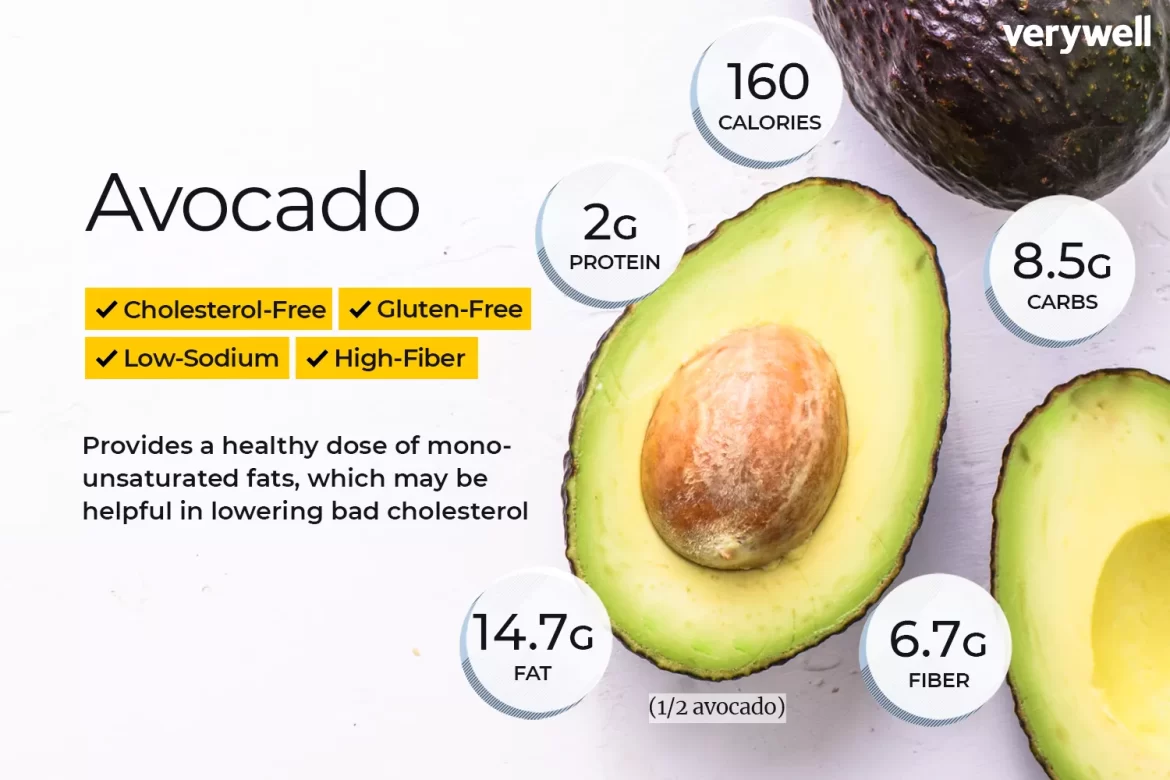
One-half of an avocado (100g) provides 160 calories, 2g of protein, 8.5g of carbohydrates, and 14.7g of fat. Avocados are an excellent nutritional source of magnesium, potassium, vitamin C, vitamin E, and vitamin K. The following nutrition information is for half of an avocado and is provided by the USDA.

Carbs

Most of the carbohydrates in an avocado come from fiber. A whole avocado provides about 17 grams of carbohydrate and 13.4 grams of fiber. Very little sugar is present in an avocado (less than one gram) and the rest of the carbohydrate in the fruit comes from starch. Avocado Nutrition Facts and Health Benefits

The glycemic index for avocado is estimated to be around zero, making it a low-glycemic food.

Fats

A whole avocado provides roughly 30 grams of fat, 4.2 grams of saturated fat, almost 20 grams of monounsaturated fat, and 3.6 grams of polyunsaturated fat. So, while most of the calories in an avocado come from fat, they are mostly in the form of healthier monounsaturated fat.

Protein

Half an avocado provides about 2 grams of protein. While it’s not a high-protein food, it can still help you meet your desired protein intake.

Vitamins and Minerals

If you consume a slice or two of avocado, it won’t provide substantial vitamins or minerals because the serving size is so small. However, an entire avocado is a good source of vitamins K, E, and C. An avocado also contains several important minerals and actually has more potassium than a banana. Avocado Nutrition Facts and Health Benefits

Vitamins and Minerals in avocados include:

  • Vitamin C
  • Vitamin E
  • Vitamin K
  • Folate (vitamin B9)
  • Niacin (vitamin B3)
  • Pantothenic Acid (vitamin B5)
  • Magnesium
  • Potassium
  • Copper
  • Manganese

Calories

The number of calories in an avocado will depend on its size. The avocado nutrition facts shown are for half of a medium-sized avocado, but many avocados are smaller and some can be much larger (up to 300 grams or more).

According to the USDA Nutrient Database, there are 322 calories in a larger (200 gram) avocado. In general, an average avocado ranges from 200 to 300 calories.

If you spread a thin layer of avocado on your sandwich or add a small amount to your healthy taco, you are probably consuming roughly 30 grams or about two tablespoons of fruit.

Health Benefits

Avocados have been studied extensively, in part, because the Hass Avocado Board funds much of the research. For this reason, It can be difficult to tell whether it is avocados specifically that provide the benefit that is studied. That said, here are a few studies and what they’ve found. Avocado Nutrition Facts and Health Benefits

May Aid in Diabetes Management

Avocados may provide benefits for people with diabetes. Although they have carbohydrates, their low glycemic index rating of almost zero means that they have little effect on blood sugar. The glycemic index is a scale from 1 to 100, with high numbers indicating foods that raise your blood sugar faster.

That means avocados are a healthy choice for those with diabetes, especially when they replace higher-glycemic foods. Some studies have shown that avocado consumption is associated with improved glycemic control in subjects with type 2 diabetes.

In addition, there is considerable evidence to suggest that high-MUFA diets can also improve metabolic health among people with type 2 diabetes. For ideas on how to incorporate avocados and other healthy fats into your diet, diabetic cookbooks can provide recipes and other meal ideas for those with diabetes. Avocado Nutrition Facts and Health Benefits

May Support Heart Health

A study published in Journal of the American Heart Association that tracked 110,00 people over 30 years found that those who ate two or more servings (a serving is half an avocado) a week had a 16% lower risk of heart disease and 21% lower risk of coronary heart disease.

Additionally, numerous research have demonstrated that avocado consumption may improve cholesterol levels in some people. Specifically, a 2022 review linked eating avocados with lower total cholesterol and LDL (“bad”) cholesterol in individuals with high cholesterol, a risk factor for cardiovascular disease. However, the review authors noted that larger, well-conducted studies are needed. Avocado Nutrition Facts and Health Benefits

In addition to exercise and lifestyle factors (such as not smoking and minimizing stress), a healthy diet that includes foods like avocadoes can help support cardiovascular health. Heart health supplements can also be beneficial for those who have a hard time meeting their nutritional requirements through food.

May Prevent Cancer

A 2019 review notes that the avocado seed extract appears to help protect against cancer thanks to being richer in sterol compounds than the rest of the fruit.  However, it is unclear whether it is safe to eat the seed. So, even avocado growers don’t recommend it.

May Lower Metabolic Syndrome Risk

After looking at the results from the National Health and Nutrition Examination Survey (NHANES), researchers concluded that avocado consumption was associated with lower metabolic syndrome risk. They also noted a connection between eating avocados and better overall diet quality.

May Promote Weight Loss

Though avocados are high in calories, they still may provide benefits if you are trying to lose weight. The creamy texture and savory taste that comes from (healthy) fat can help you to feel full and satisfied at mealtime. Avocados also provide fiber. Eating foods with fiber can promote satiety. Avocado Nutrition Facts and Health Benefits

Studies have shown an association between avocado consumption and lower body weight, lower body mass index (BMI), and decreased weight circumference. A few limited studies have also found that avocados are good for weight loss and regular consumption of avocados may be able to reduce your risk of becoming overweight.

Allergies

While avocado allergy is rare, research indicates a possible increase in cases of food protein-induced enterocolitis syndrome (FPIES)—a non-IgE mediated allergy that impacts the gastrointestinal tract—with avocado being one potential trigger.

People with oral allergy syndrome, also called pollen-food sensitivity syndrome, may also experience an allergic reaction when eating avocado. According to the American College of Allergy, Asthma, and Immunology, oral allergy syndrome is rarely associated with symptoms beyond the oral cavity, such as hives, breathing difficulty, or anaphylaxis. Avocado Nutrition Facts and Health Benefits

Adverse Effects

Avocados may decrease the effectiveness of warfarin (Coumadin). If you are taking this medication, check with your healthcare provider for a personalized recommendation.

Varieties

Many people are familiar with Hass avocados, commonly found at the grocery store. Hass avocados make up 95% of all the avocados eaten in the USA. This variety has skin with a dark, pebbly texture. But there are other varieties as well.

Other varieties include Pinkerton, Reed, Zutano, Bacon, Fuerte, and Gwen. Some of these are larger than the Hass and may have thinner, brighter skin. There are 56 types of avocado that come from Florida alone.

When It’s Best

The avocado tree has a long harvest season that sometimes overlaps from one year to the next, so the fruit can be found in most grocery stores year-round. The avocado doesn’t get ripe yet until it is picked from the tree.

Storage and Food Safety

When choosing an avocado, use both color and feel to find the best fruit. First, select an avocado with a dark but consistent color. Take it in the palm of your hand and gently squeeze it. If it yields slightly, it is ripe and ready to use. Avocado Nutrition Facts and Health Benefits

In general, you can store ripe, uncut avocados in the refrigerator for two to three days. If you eat your avocado just a tablespoon at a time, add lime or lemon juice to keep it from browning.

To ripen an unripe avocado quickly, place it in a brown paper bag with an apple or banana for two to three days. You can also freeze an avocado, but it may change the texture of the fruit.

How to Prepare

The hardest part of cooking with avocado can be removing the skin. Use these tips to peel your fruit.

  • Start at the top of the avocado and slice it lengthwise from the top to the bottom, then twist it to pull the two halves apart.
  • To remove the pit, stick the knife into it and twist it out, then discard it. This should result in two halves with the meat of the avocado unmangled.
  • Score the avocado in rows, up and down, and then side to side to make a grid. Now you can scoop out these cubes with a spoon and discard the peel.
  • Your avocado cubes are now ready to use.

Sliced avocado is a great addition to a healthy sandwich or wrap. It provides a creamy texture and allows you to eliminate the butter or mayo.

It’s also great on an English muffin or toast as avocado toast. Many people also add avocado to an omelet, on the side of scrambled eggs, or as an avocado and egg toast sandwich.

0 comment
0 FacebookTwitterPinterestEmail
Lat Pulldown

The pulldown exercise works the back muscles and is performed at a workstation with movable resistance, usually plates.

While seated, you pull a hanging bar toward you to reach chin level, then release it back up with control for one repetition. This exercise can be done as part of an upper-body strength workout.

How to Do a Lat Pulldown: Proper Form, Variations, and Common Mistakes

How to Do a Lat Pulldown

Sit comfortably on the pulldown seat, with your feet flat on the floor. Check the height of the bar. You may need to adjust the bar height by shortening or lengthening the chain or cable that supports the bar or your seat height. Get a gym trainer to help with this if necessary.

The bar should be at a height that your outstretched arms can comfortably grasp the bar without having to stand up entirely, however, you ought to be able to still extend your arms to achieve a full range of motion. If the station has a thigh pad, adjust it so that the upper thighs are securely nestled beneath the pad. This will assist you when you apply effort to the bar. How to Do a Lat Pulldown: Proper Form, Variations, and Common Mistakes

  1. Grasp the bar with a wide grip with an overhand, knuckles-up grip. Other positions and grips are possible but start with this standard position.
  2. Pull the bar down until it’s approximately level with the chin. Exhale on the downward motion. While shifting slightly backward is OK, aim to keep your upper torso stationary. Keep your feet flat on the floor and engage your abs as you pull. The bottom of the motion should be where your elbows can’t move downward anymore without moving backward. Be sure to stop at that point and do not go lower.
  3. Squeeze the shoulder blades together while maintaining square shoulders.
  4. From the bottom position, with the bar close to your chin, slowly return the bar to the starting position while controlling its gradual ascent. Don’t let it crash into the weight plates.
  5. Continue until you complete eight to 12 repetitions in a set. Rest, then continue to complete your program of sets.

Benefits of Lat Pulldowns

It is imperative to focus on your back muscles to help with proper posture and to ease pulling movements, like opening a door, starting a lawnmower, swimming, or even performing a pull-up. Having strong lats may even help relieve some kinds of back pain. How to Do a Lat Pulldown: Proper Form, Variations, and Common Mistakes

Muscles Worked During Lat Pulldowns

This exercise mainly targets the latissimus dorsi, more commonly referred to as the “lats,” which is a muscle just under the armpits that spreads across and down the back. Lat pulldowns also work teres major, a muscle located near the bottom of the shoulder blade at How to Do a Lat Pulldown: Proper Form, Variations, and Common Mistakes.

By isolating the back muscles with this exercise, you can focus specifically on them without tiring out the biceps or triceps.

Other Variations of Lat Pulldowns

You can perform this exercise in different ways to meet your skill level and goals.

Light Weights or Bands for Beginners

Beginners may want to start with light weights or a band to ensure they use the correct form. You can also try performing the exercise standing, with one leg forward as if walking.

Alternative Grips

Try wider, narrow, under- or using overhand grips to focus on particular muscle areas. Using a middle-distance grip, with forearms upright and hands about shoulder-width apart, work the biceps and middle back. A wider grip recruits more back muscles, and a close grip pulldown emphasizes the forearm muscles. How to Do a Lat Pulldown: Proper Form, Variations, and Common Mistakes

Straight Arm Pulldown

The straight-arm pulldown, which requires keeping your elbows nearly fully extended the entire time (usually done standing), hits the muscles on the back of the upper arm, known as the triceps.

Reversing Your Grip

Reversing the grip to underhand with knuckles facing downward and palms up puts more work on the muscles on the front of your upper arm, known as the biceps.

Common Mistakes

Avoid these errors so you can get the most from this exercise and prevent strain or injury.

Arching Your Back

Sit upright and keep your chest lifted as you pull the bar down. Maintaining a neutral spine can help protect your lower back from injury.

Using Your Forearms

Be sure your forearms are not doing the work of pulling the bar down—you want it to come from your back. To engage your lats, pull down on the from your armpits. How to Do a Lat Pulldown: Proper Form, Variations, and Common Mistakes

Holding the Bar Too Wide

Grab the bar just outside your shoulders, but not too wide, especially if you’re a beginner. Keep your elbows pointed down as you lower the bar and not out to the sides.

Pulling Down Too Far

Stop at the point where your elbows would need to go backward to continue pulling the cable down. If the elbows go backward, it will put excessive stress on the shoulder joint. You should only lower the bar to your chin or just below. How to Do a Lat Pulldown: Proper Form, Variations, and Common Mistakes

Using Momentum

As with most weighted exercises, perform the pulldown slowly and with control. Doing it fast uses momentum and reduces the use of the targeted muscles.

Safety and Precautions

The pulldown behind the neck is not recommended for safety reasons, as the rotation of the shoulder joint and possible spine contact with the bar could lead to injuries. How to Do a Lat Pulldown: Proper Form, Variations, and Common Mistakes

Should you possess any wrist, elbow, or shoulder problems, talk to your doctor or physical therapist to see if this exercise is appropriate. Stop this exercise if you feel any pain or too much stress on your shoulder joints.

The number of reps you do in one workout will depend on the weight used, your experience level, and strength.

0 comment
0 FacebookTwitterPinterestEmail
Dumbbell Press

The incline dumbbell press is a free weight exercise designed to target the chest, shoulders, and triceps, independently hitting each side of the body. This exercise is a great way to focus on and define your upper-chest muscles.

Unlike the more traditional flat bench press, the incline press shifts the movement’s focus to the upper portion of the pectoral muscle groups and the front of the shoulder. This makes more substantial hypertrophy (muscle growth) of the upper chest when the exercise is performed regularly.

The incline dumbbell press is designed to increase chest strength and size, so it’s typically included in a well-rounded, intermediate strength training program. If you split up your weekly workouts by body part, include this chest exercise on your upper body or chest day, after exercises like pushups or the flat bench press. How to Incline Dumbbell Press: Techniques, Benefits, Variations

How To Do an Incline Dumbbell Press

All you need to perform the incline dumbbell press is an incline bench or adjustable bench, and a set of dumbbells. It won’t take up much additional room beyond the space required for the bench itself.

If your bench is adjustable, set the incline to between 30- to 45-degrees. The bigger the angle, the more the exercise will make your shoulders work.

You’ll want to select dumbbells that are lighter than you’d use for a flat dumbbell bench press and when performing a barbell incline press. If you’re unsure of the right weight, start light and work your way up until you feel challenged but can still do an entire set using proper form. How to Incline Dumbbell Press: Techniques, Benefits, Variations

  1. Sit on the bench and lean back. Hold a dumbbell in each hand, with hands positioned at your shoulders, elbows bent and angled down below your ribs. Relax your neck against the bench. Keep your feet flat on the floor.
  2. Brace your core and press both dumbbells straight over your chest as you exhale. Keep your wrists straight (don’t let them “cock” backward). At the top of the movement, the dumbbells should almost touch each other, and your arms should be perpendicular to the floor.
  3. Reverse the movement and slowly lower the dumbbells to the top of your chest as you inhale. As you lower the dumbbells, your elbows should come down at roughly a 45-degree angle to your torso. They shouldn’t splay out to the sides, pointing toward the side of the room. Instead, keep your elbows pointing to the floor.
  4. Aim to complete sets of 8 to 12 reps. Start with one set and work up to two to three sets over time as you build strength. When you finish your set, safely exit the exercise by sitting up and placing the dumbbells on your knees before you stand up. Avoid dropping the dumbbells while you’re lying on the incline bench.

Benefits of The Incline Dumbbell Press

The dumbbell incline press targets the upper portion of the chest—specifically, the clavicular head of the pectoralis major— a section of the chest almost completely unengaged during other common chest exercises, like the traditional bench press, incline pushups, and chest fly. The incline press also hits the anterior head of the deltoid muscle of the shoulders or the front part of your shoulder. How to Incline Dumbbell Press: Techniques, Benefits, Variations

Functionally, the dumbbell incline press transfers naturally to a range of pushing and pressing motions, such as pushing open a heavy door or putting groceries away on elevated shelves.

The dumbbell version of the incline press is especially beneficial for correcting strength imbalances between each side of your body. It’s common for one arm to be stronger than the other. By using dumbbells to perform this exercise, each arm works independently, which prevents the dominant arm from “taking over” to complete the lift, improving strength and stability on both sides of the body.

Other Variations of The Incline Dumbbell Press

The incline dumbbell press can be modified in various ways or made more challenging to suit individual needs and fitness goals.

Barbell Incline Press

If isolating each shoulder independently doesn’t work for you, you can modify the exercise and still get similar results. Instead of the dumbbell incline press, opt for the barbell incline press. The barbell exercise targets the same muscle groups in the same way but doesn’t require the One-sided control needed for the dumbbell press. How to Incline Dumbbell Press: Techniques, Benefits, Variations

This exercise will help you develop the baseline strength required for the movement while also starting to engage the stabilizing muscles of the shoulders without isolating each shoulder independently.

Perform the exercise in the exact same way as the dumbbell press, except using a barbell gripped with both arms instead of individual dumbbells. Set the bench at a 30 to 45-degree incline under a rack with the bar loaded. Grip the bar wider than shoulder width.

  1. Unrack the weighted bar and slowly lower it to your chest.
  2. Touch the bar to your chest, then lift the bar by extending your arms. Avoid locking out to maintain tension on your chest muscles.
  3. Repeat for desired repetitions before re-racking.

Kettlebell Incline Press

Make the exercise harder by switching out your dumbbells for a set of kettlebells. Due to the uneven weight distribution of kettlebells (the “bell” portion weighs more than the handle of the equipment), it requires more stability and control to perform the exercise correctly.

This exercise is otherwise performed in the same way as the incline dumbbell press, but you’re pressing kettlebells with each hand, rather than dumbbells. How to Incline Dumbbell Press: Techniques, Benefits, Variations

Single Arm Incline Press

Additionally, you can actively participate in your core by performing the exercise as a single-arm kettlebell incline press.

  1. Use only one kettlebell at a time, performing a complete set with your right arm before switching to your left arm. This single-sided exercise requires your core to engage to prevent your non-working side from rotating toward the side you’re working.
  2. Engage your core to prevent your left shoulder and hip from rotating to the right as you perform the movement.

Common Mistakes During An Incline Dumbbell Press

This exercise can seem deceptively simple, making it easy to overlook possible mistakes. Read on to learn about potential issues as well as how to avoid them. How to Incline Dumbbell Press: Techniques, Benefits, Variations

Using Too Much Weight

If you’ve been doing dumbbell bench press or incline barbell press for a while, you probably have a good idea of how much weight you can handle for these exercises. However, that doesn’t mean you’ll be able to lift the same amount when trying the dumbbell incline press.

The incline press, as a whole, uses smaller muscle groups than the flat bench press, so you’ll need to decrease your weight a bit for the incline press. Even if you’re familiar with the incline barbell press, you may still need to reduce your weight for the dumbbell version of the exercise.

This is because the dumbbell press requires each arm to lift its dumbbell independently, which requires more strength. This action is more challenging to control and ends up using more of the stabilizing muscles of the shoulder. Selecting a lighter weight helps ensure you can complete the exercise safely. How to Incline Dumbbell Press: Techniques, Benefits, Variations

Cocking Your Wrists

Cocking your wrists backward while holding the dumbbells—forming a 90-degree angle between the back of your hand and forearm—may not seem like a big issue, but holding the dumbbells this way puts a lot of strain on your wrists. Focus on keeping your wrists straight so that they’re perpendicular to the ground throughout the exercise to prevent wrist injury.

Choosing the Wrong Angle For Your Bench

Doing a chest press on a flat bench positioned at 0-degrees targets the middle of your pecs. Likewise, doing a press on an upright bench positioned at 90-degrees targets your shoulders. To efficiently target your chest’s upper region, you need to select an angle somewhere between those two angles.

The trick, though, is selecting the right angle to work the muscles you want to strengthen. Generally speaking, you should set your bench between 30- and 45-degrees. The 45-degree angle will hit more of your shoulders, while the 30-degree angle will target the pecs to a greater degree. How to Incline Dumbbell Press: Techniques, Benefits, Variations

Bouncing the Dumbbells Off Your Chest

Lowering the weights quickly and “bouncing” them up off the top of your chest is ineffective. If you find yourself doing this (or if you are tempted to do so), that’s a good indication that you’re lifting more weight than you should be.

When you speed through a movement like this, you end up losing the target focus for the exercise, allowing other muscle groups and momentum to help you complete the move. This may not seem like a big deal, but it ends up reducing the effectiveness of your workout, making visibility more difficult the improvements you want to see.

Over-Arching Your Back While Pressing

When you are fatigued toward the end of a set or if you’re trying to lift more weight than you should, you may find yourself straining and over-arching your back to try to force the dumbbells upward. This can open you up to the possibility of a back strain. Also, your efforts will be shortchanged.

You’ll end up recruiting muscle groups other than the specific muscles intended to be targeted by the exercise. There is a natural arch in your back that should be there while performing this press exercise. You don’t want to eliminate this natural curve. When you try hard to push your back into the bench, your shoulders will naturally roll forward. Try to maintain the natural arch without increasing it. How to Incline Dumbbell Press: Techniques, Benefits, Variations

If you find yourself straining toward the end of a set, ask a friend to spot you as you lift. This will allow you to finish your set without altering the movement. If you find yourself over-arching your back from the get-go, choose a lighter set of dumbbells.

How to Safely Do an Incline Dumbbell Press

When performing the incline dumbbell press, the most important thing is to select an appropriate weight for your strength level, which is probably less than you think. You should be able to complete between 8 and 12 repetitions with the weight you select for a typical workout routine.

The dumbbell incline press is generally a safe exercise, but it requires a baseline level of strength, and it shouldn’t be attempted if you’re new to strength training. In that case, start with machine weights or a barbell incline press to grow accustomed to the movement, then move on to the incline dumbbell press once you’re ready.

The incline press can be problematic for those who experience shoulder pain. If you have ongoing shoulder pain, attempt the exercise on a machine or with a barbell before trying it with dumbbells. If you experience sharp or shooting pain at any point during the exercise, stop and opt for exercises that don’t cause pain.

0 comment
0 FacebookTwitterPinterestEmail
Squat

The Bulgarian split squat is a alternative to the single-leg squat where the back leg is elevated on a bench or a sturdy chair. As a unilateral squat, the exercise focuses more on the quadriceps than similar lower-body compound movements. It also requires a lot of balance and coordination, increasing the core and upper body engagement required to maintain proper form.

The Bulgarian split squat is a great movement to add to a lower-body strength or total-body workout routine. Due to the compound, balance-focused nature of the movement, it’s a good idea to include it toward the beginning of a workout, perhaps after a solid warmup including traditional squats, Romanian deadlifts, or barbell snatches. If you’re ready to fire up your quads and grow your glutes, read on for ways to try the highly-effective exercise.

Bulgarian Split Squat Muscles Worked

As a compound lower-body exercise, Bulgarian split squats work many muscles of the legs at the same time. Bulgarian split squats primarily work the quadriceps along the front of the thighs. Other muscles include the hamstrings along the back of thighs, glutes of the buttocks and hips, and calves along the back of the lower legs.

Bulgarian split squats also include a balance challenge to keep you steady on one leg. This keeps core muscles, encompassing the muscles of the abdomen and spinal erectors (run along the spine), engaged throughout the movement.

How to Do a Bulgarian Split Squat

The main thing to remember about the Bulgarian split squat is that it takes some trial-and-error to find proper foot placement to perform the exercise comfortably. You’ll place one of your feet on a bench behind you, but you may need to hop your front foot around a little bit to help you find the exact position that feels best. It’s okay to try a few practice repetitions before starting your actual set to make sure you’re set up appropriately.

All you need for the most basic version of the Bulgarian split squat is a bench or a sturdy chair. As you become comfortable with the exercise, perhaps add some dumbbells or kettlebells for increased resistance.

  1. Stand roughly two feet in front of a sturdy bench or chair, your feet hip-distance apart, your core engaged, your shoulders back, and your chest and eyes pointing straight ahead.
  2. Pick up your right foot and place it on the bench behind you. You can do this in one of two ways. One option is to place the top of your foot on the bench so that your ankle joint is roughly aligned with the edge of the bench. The other option is to flex your ankle and find your balance with the ball of your foot and your toes, more like during a traditional lunge exercise.
  3. Ensure your feet are still roughly hip distance apart, if not slightly wider. You don’t want your elevated foot directly behind your front, making balancing much more difficult.
  4. Remember, your back foot is just there to help you stay balanced—the engagement and movement of the exercise are focused on the front leg.
  5. Engage your core with your chest high and eyes looking straight ahead, and bend your left knee, allowing your right knee and ankle to naturally bend as you move through the downward phase of the exercise without taking on the load with your back leg.
  6. Keep the load balanced evenly across your left foot as you lower. Hinge slightly forward at the hips, ensuring your left knee remains aligned with your left toes (that it doesn’t cave inward or bow outward). You may find that your left knee starts to protrude slightly over your left toes toward the bottom of the exercise. This isn’t necessarily bad or wrong and only depends on your level of comfort and the flexibility you have at your ankles.
  7. Inhale through this downward phase, lowering down until your left quadriceps is roughly parallel to the ground.
  8. Press back to standing by pushing through your left foot and using your left quad and glute to power the upward phase of the exercise. Exhale as you press to standing.
  9. Step your right foot off the bench or chair after completing a full set to one side. Ensure you keep things even by performing the same repetitions and sets to each side.

Benefits of Bulgarian Split Squats

The Bulgarian split squat is an excellent way to take your lower-body training to the next level. This movement targets all the same muscle groups you see targeted during squats and lunges—quads, glutes, hamstrings, calves, abdominals, and spinal erectors—but places greater focus on the quadriceps and core due to the single-leg, balance challenge that the exercise provides.

Any time you can work your body unilaterally—meaning that you target one side of your body independently from the other—you have the opportunity to improve side-to-side muscle imbalances.

By improving these imbalances, you’re less likely for one side to “take over” when bending, lifting, or moving through life, making it easier for you to maintain proper alignment and avoid injuries over time.

These exercises may also improve your agility, and core strength, making it less likely that you’ll experience a fall when knocked off balance. Maintaining your balance as you age could mean that you experience fewer falls are more likely to avoid life-altering injuries like hip or wrist fractures.

Bulgarian Split Squat Variations

Below are variations for doing a split squat without a bench or adding weight to the task, a resistance band, or an exercise ball.

Split Squat

While “split squat” and “Bulgarian split squat” are often used interchangeably, they’re two different variations of the exercise. The Bulgarian split squat refers to the version where the back leg is elevated on a bench or a sturdy chair, while the split squat is the version performed without the rear leg elevated.

Remember, this isn’t the same as a lunge where the back leg is also engaged in the exercise.

  1. Perform the exercise in the same manner, but with your back foot on the floor.
  2. Use your back leg to help with balance, but the front leg should support the entire movement.

Weighted Bulgarian Split Squat

Once you’ve mastered the proper form, make things harder by adding weights.

  1. Hold a pair of dumbbells or kettlebells in your hands to ramp up the difficulty of the exercise.
  2. For an even more challenging variation, place an unloaded or loaded barbell across your shoulders before performing the Bulgarian split squat.

Bulgarian Split Squat with Resistance Bands

Another variation that adds a challenge is to use a resistance band. The band adds resistance as you lift out of the squat.

  • Place the resistance band under your front foot.
  • Bend your arms to bring the resistance band in line with your shoulders as you perform the Bulgarian split squats.

Bulgarian Split Squat with an Exercise Ball

If you want to add more of a challenge for your core muscles, you can use an exercise ball.

  • Elevate your back leg onto an exercise ball instead of a bench or chair.
  • Move slowly to keep proper Bulgarian split squat form even though your core is working harder to maintain your balance through the exercise.

Common Bulgarian Split Squat Mistakes

There are a few common mistakes made when performing Bulgarian split squats. Here’s what to watch for.

Placing the Back Leg Directly Behind the Front

If your rear foot is directly aligned behind your front foot, you’ll have a tough time balancing throughout the exercise. Because your front leg powers the motion, this is already a unilateral balance challenge, forcing you to maintain balance as you move through a squat supported primarily by your front foot.

When you place your back foot on the bench behind you, make sure it’s roughly hip distance apart from your front foot or even slightly wider. Even though you’re not powering the exercise with your back foot or leg, having this wider “kickstand” for support will help you complete the Bulgarian split squat effectively.

Leaning Too Far Forward From the Hips

It’s tempting and common to lose focus on your core—particularly your abdominals and spinal erectors—as you move through the downward phase of the Bulgarian split squat. Not only does this forward lean limit the core benefits of the exercise, but it makes you more likely to place too much stress on your front knee, shifting your weight too far forward. (A slight lean is fine.)

Additionally, if you progress to a Bulgarian split squat with a barbell balanced across your shoulders, a forward lean as you squat will likely lead to injury. Before starting the exercise’s downward phase, re-engage your core muscles and roll your shoulders back. Try to keep this same posture and alignment throughout each repetition.

Rising Onto the Toes

A bad habit that sometimes occurs when your alignment and form are otherwise poor is to rise onto the ball and toes of your front foot as you squat down. This usually indicates one of two things: 1) your front foot is too close to the bench, and you need to move it forward to maintain better balance and alignment, or 2) you’re leaning forward at your hips as you perform the squat, and you need to rise onto your toes to support the forward shift in your weight to remain balanced.

Should you ever discover yourself ascending onto the ball or toes of your front foot, stop the exercise and reset. Check the placement of your front foot—you may need to shift it forward—and ensure you’re keeping your torso upright and tall as you perform the exercise.

Supporting the Movement With the Back Leg

Remember, the Bulgarian split squat is a form of single-leg squat. While the back leg is intended to help with balance, it’s not supposed to be engaged to perform the exercise, making it more of a lunge. At any given point of the movement, you should be able to “shake” your back leg to ensure it’s still loose and not engaged in supporting your weight.

Allowing the Front Knee to Lose Alignment

As with all squat and lunge variations, one standard and significant mistake during the Bulgarian split squat are to allow the front knee to shift inward or outward, losing alignment with the same-side toes. This places way too much stress on the knee, especially during single-leg exercises, where the weight and resistance are all being supported by one leg.

Safety and Precautions

Proper setup and effective core engagement are hands-down the best ways to ensure the Bulgarian split squat remains safe. Take your time to find appropriate foot alignment and placement, so you’re not tempted to lean forward from the hips and throw your center of gravity in front of your front knee. This places too much stress on the knee and could lead to injury.

If you’re brand-new to strength training, or if you struggle to remain balanced while performing traditional lunges, you probably aren’t ready to try the Bulgarian split squat yet. Likewise, if you have knee or ankle pain or injuries, the flexibility and mobility required to perform this movement correctly may not be comfortable for you.

If you feel any pain or discomfort, discontinue the movement and try the split squat variation with your back foot balanced on the floor.

0 comment
0 FacebookTwitterPinterestEmail
Glute Exercises

If you want to build stronger glutes, you’ll want to do exercises and activities that target those muscles. The “glutes” are actually three different muscles—the gluteus maximus (the largest muscle), the gluteus medius, and the gluteus minimus. Read on for 7 moves to try that will strengthen your posterior.

7 Best Glute Exercises for a Stronger Butt

What Are Glutes?

The glute muscles are located under the The fat in your buttocks. They consist of three muscles including the gluteus maximus, gluteus medius, and gluteus minimus. Your glutes are large, strong muscles that facilitate walking, run, sit, stand, and many other movements. You can increase the size of your glutes with strength training and proper nutrition. 7 Best Glute Exercises for a Stronger Butt

You can’t always change the shape of your glutes, however, you can stiffen them and stronger with the right exercises. The key is working all the muscles from different angles with different exercises and cardiovascular activities. Try any of the exercises below to target and strengthen your glutes.

Squats are one of the best exercises to target the gluteus maximus—the largest muscle in the lower body. They also work your hips, thighs, calves, and core

How to Do Squats

  1. Stand with your feet hip-distance apart. For added intensity, hold weights at shoulder level or at your sides.
  2. Bend your knees and lower into a squat. Keep your knees behind your toes (imagine that you’re sticking your butt out behind you, but keep your torso upright and contracted).
  3. Press into your heels to stand.
  4. Repeat for 2 to 3 sets of 8 to 16 reps

If you feel up to the task, try the Bulgarian split squat. The move requires you to balance on one leg while elevating the other on a bench or sturdy chair. With this transition, the workload will be transferred to the quads of the front leg, however, the glutes are also engaged. 7 Best Glute Exercises for a Stronger Butt

Lunges

Lunges are a favorite butt exercise. In a staggered stance, you really have to use your glutes to stabilize your body. The stance also forces the glutes on the front of your legs to work even harder.

Lunges exercise more muscles including your hamstrings, quads, and calves.

How to Do Lunges

  1. Stand with your feet staggered, one foot forward and one foot back (about 3 feet apart).
  2. Bend both knees and lunge straight down, sending your back knee toward the floor.
  3. Try not to lunge forward over your front toes. Keep your front heel on the ground.
  4. Press into your heel to stand.
  5. Repeat for 1 to 3 sets of 12 to 16 reps. For added intensity, hold some weights.

One of the best things about lunges is that there are many varieties. You can easily mix it up to target your muscles in different ways. For example, elevate your back foot on a step or platform to really challenge both legs. 7 Best Glute Exercises for a Stronger Butt

Step-Ups

Step-ups are another great exercise to work your butt. To get started, make sure that you choose a platform high enough that your knee is at a 90-degree angle when bent. If that’s a little too much, use the second stair on a staircase and hold onto the rail for balance.

How to Do Step-Ups

  1. Stand in front of the step or platform. Place your right foot on the step.
  2. Pressing into your heel, step up, touching your left toes to the step.
  3. Keeping your right foot on the step, bring your left foot down to the floor. Bend your knee into a lunge for more intensity.
  4. Repeat for 1 to 3 sets of 12 to 16 reps on each side. For more intensity, try holding weights or a resistance band under your standing foot.
  5. Push into your heel to lift the body and concentrate all your weight on your stepping leg.
  6. Lower down gently, barely touching the toes of your other leg to the ground. If you take it slow and concentrate on the working leg, you’ll really feel this move.

Sidestep Squats With Resistance Bands

Although the earlier exercises primarily focus on the gluteus maximus, this move targets the smaller gluteus medius and minimus. Don’t worry, though, the gluteus maximus is still involved because you’re squatting. 7 Best Glute Exercises for a Stronger Butt

How to Do Sidestep Squats

  1. Use a band with medium-light tension. Stand on it, holding both handles.
  2. Take a wide step out to the right into a squat, keeping tension on the band.
  3. Step your left foot in. Continue stepping out and squatting to the right, all the way across the room (or as far as you can).
  4. Repeat the other way or for about 1 to 3 sets of 8 to 16 steps.

Hip Thrust / Glute Squeeze on Ball

The hip thrust on a ball is another excellent selection for employment your glutes. The ball adds some instability and forces your entire lower body to work. Holding weights on the upper thighs adds more intensity to the exercise. 7 Best Glute Exercises for a Stronger Butt

How to Do Hip Thrusts

  • Begin in a bridge position with your head resting on the ball and your butt lifted. If you want, place weights on your thighs for added intensity.
  • Lower your hips to the ground. Try not to let the ball roll around.
  • Squeeze your glutes to lift back to your starting position.
  • Repeat for 1 to 3 sets of 8 to 16 reps. Try lifting your toes for a more intense move.

Hip Extensions

Although the prior complex exercises are the go-to choice for working multiple muscles at the same time, hips extensions are perfect for targeting the glutes in a more focused way. You’ll also benefit from some core and shoulder activation. 7 Best Glute Exercises for a Stronger Butt

How to Do Hip Extensions

  1. Get on your hands and knees, with your hands directly under your shoulders and your knees directly under your hips.
  2. Keeping the right knee bent, lift your right leg up until it is level with your glutes.
  3. Lower your leg.
  4. Repeat for 12 to 16 reps on each side.
  5. To add intensity, squeeze a weight in the back of your knee or use ankle weights.

One-Legged Deadlifts

Deadlifts are great for your glutes, hamstrings, and lower back, but this one-legged version is an especially good butt workout. Doing anything on one leg adds intensity and it also involves your stabilizer muscles to keep your body balanced.

How to Do Deadlifts

  1. Holding weights, take your left leg back behind you (about a foot or so) and lightly rest on your toe.
  2. Tip from your hips and slowly lower the weights to the floor as far as your flexibility allows.
  3. Keep your back flat (or with a natural arch). Make sure you keep your abs contracted to protect your back.
  4. Squeeze the glutes of your working leg to bring it back up.
  5. Do 1 to 3 sets of 8 to 16 reps on each side.

Other Activities to Improve Strength in Your Glutes

The previous strength exercises aren’t the only moves for the glutes—cardio activities can also be an effective way to engage your backside. Try out any of these workout programs activities to improve your glute strength.

  • Walking up an inclineautomatically gets your glutes more involved. If you’re wearing a backpack, you’re getting even more of a workout.
  • Kickboxinginvolves complex combinations that target your upper and lower body and abs to make them stronger. For instance, a 140-pound woman can burn up to 500 calories with 45 minutes of kickboxing.
  • Hiking works the glutes and also burns a ton of calories. Not only do you work harder if you are hiking uphill, but you’ll expend even more energy if there’s a change in altitude. A 140-pound person burns about 390 calories in about an hour while hiking. If you live in a flat area, try raising the incline on your treadmill to mimic trekking up a hill.
  • Biking is another great way to engage the glutes. If there are no hiking trails in your area, consider cycling (indoors or out).

0 comment
0 FacebookTwitterPinterestEmail